


This week, the article selected from Portsmouth Point for the website is by Siha H in Year 13.
Cancer, simply defined, is the uncontrollable growth and spread of cells, as a result of genetic mutations resulting in abnormalities of DNA in cells. This often results in masses of cancerous cells forming tissues known as tumours, which can be particularly dangerous if they form in major organs and therefore impact their function, such as the lungs or brain. Any and every cell in the body could become cancerous, all cells are capable of accumulating mutations which could eventually result in disabling the genes which repair DNA or control cell growth. The only reason as to why not everyone is suffering from cancer is because of our body’s own immunosurveillance, which is where cells are killed by our own immune system’s T cells before they can progress, after being identified by B cells.
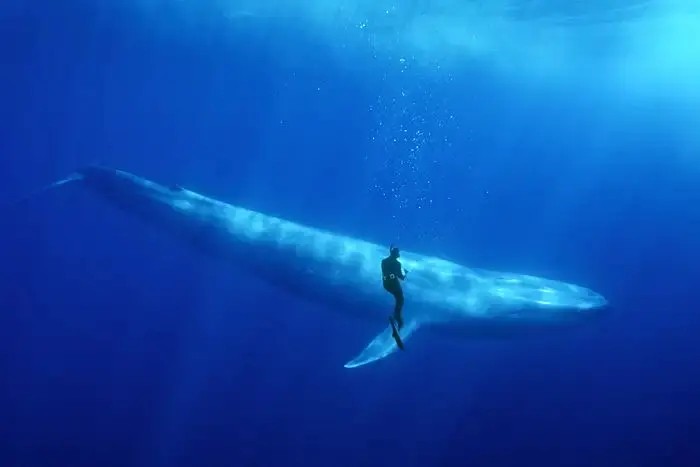
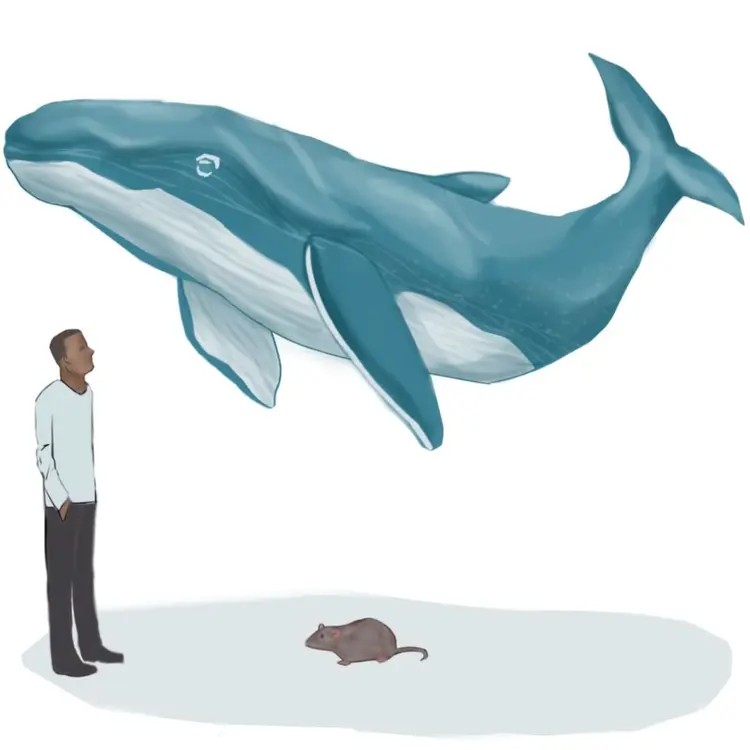
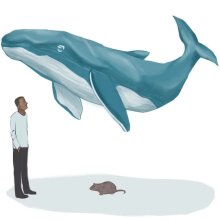
Bowhead Whale and Diver
Therefore, it could be said that the more cells in an organism, and the longer they live, the greater their chances of developing cancer. However, if that were true, then large organisms, such as the blue whale, with over 100 quadrillion cells, and a lifespan of 90 years, should theoretically develop many cancers, and live with them as a natural part of life - only they don’t.
The fact that large and long-living organisms do not have a higher incidence of cancer compared to smaller organisms despite their objectively higher chance of developing the disease is known as Peto’s Paradox, named after the British epidemiologist Sir Richard Peto. The paradox would suggest that evolution has produced its own preventative treatment for cancer, only supporting larger organisms. Several hypotheses have been proposed.
One of these includes an enhanced tumour suppression system. Tumour suppressor genes can slow the cell cycle by producing inhibitory proteins, therefore regulating cell division. They can identify damaged DNA and initiate cell repair, and trigger pauses in the cell cycle to allow this to occur. If the damage is too great, they can even signal for apoptosis - programmed cell death. Humans have one copy of tumour suppressor genes, whereas elephants have twenty, which means their cells have a far higher sensitivity to DNA damage, and can therefore trigger apoptosis with greater efficiency.
Another theory is that larger animals have lower metabolic rates, which result in the production of fewer ROS (Reactive Oxygen Species), which are simply reactive molecules containing oxygen, and are a byproduct of an aerobic metabolism. As well as the above, long-living mammals appear to have enhanced DNA repair capabilities, such as in the bowhead whale, which can live for up to 200 years. Recent research by biologist Dr Vera Gorbunova at the University of Rochester demonstrates that the 80,000kg whale requires fewer mutations in its fibroblasts (collagen-producing cells) in order for them to become cancerous. Despite this, they show a higher expression of the cold-inducible RNA-binding protein, CIRBP, within these cells and tissues, and it is likely the reason behind their impressive cancer suppression.
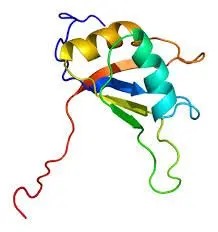
Protein Structure of CIRBP
CIRBP has several functional roles, including regulation of the circadian rhythm (the body’s sleep clock), regulation of the metabolism, and protecting cells from UV-based DNA damage. CIRBP facilitates the repair of double strand breaks in DNA, a major type of DNA damage where both strands of the double helix are severed by ionising radiation, oxidation-based damage, or UV light. It initiates repair by promoting the ‘rejoining’ of the broken ends, as well as by acting as a protective shield encapsulating the broken end of the damaged DNA, therefore preventing its further degradation and further mutations. CIRBP is of course triggered by the cold, and so it is suited for the whales, as their habitat in the arctic environment helps maintain the high levels of this protein.
The bowhead whale has around 100 times more of the protein than humans, and the rapid repair of the DNA’s double strand breaks, rather than its elimination, reduces the overall accumulation of mutations, therefore giving this whale species a greater genome stability and its abnormal resistance to cancer throughout its long lifespan.
There is some debate however about whether or not Peto’s paradox is a real phenomenon, due to the existence of larger species which do not or develop little cancer being anomalies to the expected.
A study from research completed by University College of London, the University of Reading and Johns Hopkins School of Medicine demonstrates that larger animals do in fact generally develop cancer more frequently, disproving the paradox. A study observed data of animals from almost 300 varied species, from mammals to birds, and how often they developed cancer. It became apparent that larger animals develop cancer more frequently, however also possess better natural defences against it. An example of this are elephants, which ultimately have the same cancer risk as a tiger, which is a tenth of its size, due to having additional tumour suppressor genes. Exceptions and anomalies exist - the budgie, an animal about the size of a human fist, has a risk of cancer four times greater than its size would suggest.
Therefore, the weight of the evidence would suggest that whilst specific animals can reflect Peto's paradox, such as elephants and the bowhead whale, it is not a fact of nature that larger animals possess a greater capability to suppress cancer.
Cancer treatments and preventative measures against the disease are some of the most highly researched matters today in the medical world. The new discoveries on bowhead whales and their ability to repair mutated DNA encourages research to shift their focus from destruction of the cancer cells to strengthening the body’s ability to repair mutations, and also highlights the CIRBP protein as a new therapeutic target - which already shows effectiveness in repairing double strand break mutations in human DNA.
Useful links:
https://pmc.ncbi.nlm.nih.gov/articles/PMC3060950/ - on Peto’s Paradox generally
https://www.nature.com/articles/s41586-025-09694-5 - Bowhead Whales, CIRBP
https://pmc.ncbi.nlm.nih.gov/articles/PMC4712340/ - General DNA repair in large organisms
https://www.ucl.ac.uk/news/2025/feb/bigger-animals-get-more-cancer-defying-decades-old-belief - Disproving Peto’s Paradox
https://www.pnas.org/doi/10.1073/pnas.2422861122 - Disproving Peto’s Paradox