





Portsmouth Point is the official blog of PGS's magazine of ideas and culture. The article we are highlighting this week is by Steven S in Year 12.
The History of the Samurai in Feudal Japan
Heian Period (794-1185) 391 Years.
Samurai originated in the year 794 AD, This was during the Heian Period (794-1185) which is not actually a part of Feudal Japan but instead Classical Japan. Samurai formed as a result of the conflict between Japanese people and the northern tribes comprised of the Ainu race who are believed to be descended from some of the earliest inhabitants of Japan. The land between the city of Kyoto and the North traditionally acted as a buffer between the Emperor and the northern tribes. As a result these borderlands produced the strongest soldiers in the country.
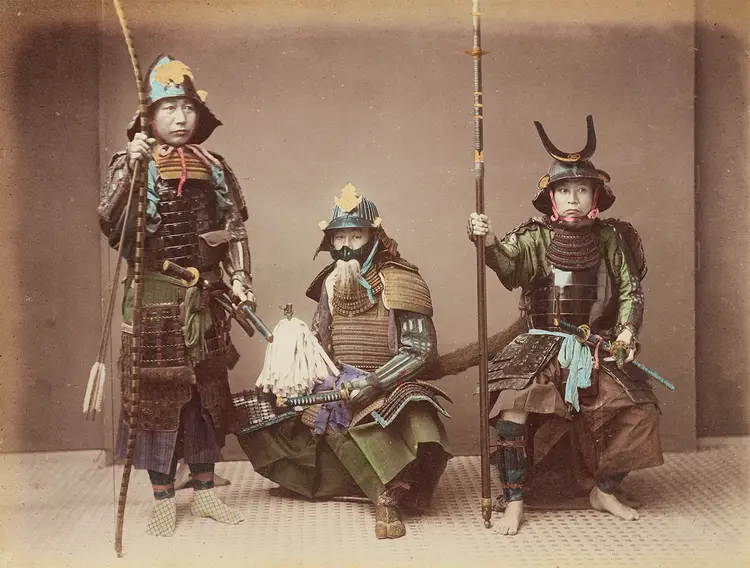
These soldiers had primarily trained in horseback archery for combat, using the Yumi as their primary weapon. The Yumi was an asymmetrical long bow that was designed for use on horseback. It was made using laminated bamboo and wood and often lacquered in black,red, or gold and reinforced with rattan to enhance its strength and elasticity. During the Heian Period archery was a central skill for samurai. During the late Heian Period as battles on foot increased the use of polearms and swords increased. One weapon that was used frequently in these battles is the Yari. The Yari is a straight headed spear that was favoured because of its longer reach and effectiveness against cavalry. The Yari was used in a dominant style of warfare known as “Kisha-Sen”. Kisha-Sen was a duel where mounted samurai and mounted Ainu would shoot arrows at each other while passing on horseback. The Yari’s design featured a straight flat blade that was typically around 30 cm in length. This made it very effective at thrusting during close quarters combat, and was often used in organized infantry formations.
The landowners that had control of these strong warriors were tasked by the Emperor to subdue the Ainu, which were considered to be ‘barbarians’ by the Japanese. Once the Ainu were subdued the warrior families of the borders who had fought them for generations were rewarded with tax-exempt territories. The heads of these clans (Warrior Families) were believed to be able to trace their lineage back to the gods and their men were of high-born status. They became known as samurai warriors and they believed in loyalty to their warlord above all else.
The various powerful clans in Japan started to compete against each other with the strongest increasing their holdings through the spoils of war. From this three powerful rivals emerged, the Fujiwara, the Taira and the Minamoto clans.
The first of these clans to dominate was the Fujiwara clan, who had close ties with the emperor By 850 AD, the Fujiwara Clan had almost complete control over the emperor and his government as they held most administrative and military posts of any importance. The head of the family would be a regent to child emperors and would be the first minister to an adult emperor. When an emperor of Japan married, they would be wed to a Fujiwara bride putting the clan in a perfect position to rule the country, with the emperor becoming a puppet ruler, controlled by the head of the Fujiwara Clan. However, throughout the Heian Period, the insulated government became weaker and weaker and its hold on power outside the capital diminished; as a result, so too did the overall power of the Fujiwara Clan.
The Taira and the Minamoto clans were growing in strength between the tenth and twelfth centuries by defeating neighboring clans in battle and claiming their land and wealth. These two clans would clash twice in the future that would ultimately bring an end to the Heian Period. In 1160, Yoshimoto Minamoto from the Minamoto clan was killed by Kiyomori Taira of the Taira clan. Unusually for the time the Taira clan allowed for three of Yoshimoto Minamoto’s sons to live. Their names? Yoshitsune Minamoto, Noriyori Minamoto and Yoshimoto’s heir Yoritomo Minamoto. However this was a grave mistake for the Taira clan as Yoshitsune and Yoritomo both decided to learn martial arts at a young age to attempt to avenge their father’s death when they were older.
Both Yoshitsune Minamoto and Yoritomo Minamoto grew up to be great warriors and samurai legends that, in a series of decisive battles known as the Gempei Wars the final battle where Yoritomo exacted his revenge was the battle of Dannoura. Yoritomo Minamoto had defeated the Taira clan leaving Yoritomo Minamoto as the ipso-factor ruler of Japan. Yoritomo then cemented his position with a number of political changes and brought an end to the age in which the samurai legend was born, the Heian Period, and in its place in 1185, the Kamakura Period began.
Kamakura Period (1185-1333) 148 Years.
The Kamakura Period started in 1185 when Yoritomo Minamoto became the first shogun of Japan after defeating the Taira clan in the Gempei Wars. He set up a military government called the bufaku (tent government) and moved away from the traditional western capital city of Heian-Kyo (Currently called Kyoto) to the city of Kamakura. In doing so Yoritomo became the most powerful man in the country though he did allow the emperor to retain his title. Two years earlier at the end of the Heian Period, Yoritomo had given his blessing for Go-Toba to become the emperor after predecessor, Emperor Antoku had fled the capital. However the shogun (Yoritomo) had ordered Go-Toba to remain in Heian-Kyo and serve more as the ceremonial figurehead than a ruler, this did not change for most of the ensuing centuries up to the Meiji Restoration in 1867.
The samurai served as military nobility, responsible for maintaining law and order, collecting taxes, and administering lands through a feudal system known as the shōen system, where they were granted land in exchange for military service. The shōen system underwent significant transformation as Yoritomo consolidated his power. Originally, shōen were private, tax-free, and often autonomous estates granted by the emperor to the imperial family, nobles, temples,shrines and the warriors that fought against the Ainu tribes in the Heian Period, which became independent of the central government and contributed to the decentralization of power. By the end of the Heian Period, nearly all Japanese land had become shōen, and they continued to exist throughout the Ōnin War and into the Sengoku period.
With the establishment of the Kamakura Shogunate (Yorimoto Minamoto) in 1185, the shogunate introduced a new administrative structure to assert control over these estates. Yoritomo Minamoto created the offices of shugo (military governors) and jitō (estate stewards), who were appointed from the shogun’s loyal vassals to manage and collect taxes from shōen. This marked a shift from the previous system where absentee proprietors controlled the estates, as the shogunate now inserted itself into the shōen hierarchy, weakening the power of traditional landlords.
The shogunate also confiscated lands from nobles and warriors who opposed it during the Jōkyū disturbance of 1221 and redistributed them to loyal retainers, further embedding the lord-vassal relationship within the shōen system. As a result, the jitō and shugo, who operated at a distance from the central government, gradually accumulated power and evolved into powerful regional leaders, eventually becoming the first daimyo, also known as feudal lords. This process laid the foundation for the rise of the samurai class and the militarization of Japanese society. Although the shōen system persisted into the 15th century, it gradually declined as villages began to self-govern and owe direct allegiance to daimyo, who subdivided land into fiefs and collected fixed taxes. The system effectively ended by the middle of the 15th century, replaced by a more centralized feudal structure under the daimyo. The Kamakura shogunate’s management of the shōen system played a crucial role in the transition from court-based governance to military rule in Japan.
Despite the shogun having control over a lot of the country there was still resistance. This mainly came from the Fujiwara clan in the north that even though they were weakened from their former power, the Emperor's Court still continued to hold jurisdiction over a lot of land that presided in the west. However by the time of Yoritomo Minamoto’s death in 1299, he had successfully eliminated most of the serious challenges to his rule but under the reign of his son and heir Yoriie Minamoto, Minamoto rule soon began to crumble. This is because Yoriie Minamoto did not have the support from the other samurai warlords that his father had enjoyed.
Early into Yoriie’s shogunate, his maternal grandparents set up a regency to take over official business. The new regents (Shikken) were all from the Hojo clan, a branch from the Taira clan who had sided with the Minamoto clan during the Gempei wars. From this time, the shogun, often selected from the ranks of the Fujiwara clan, became a figurehead like the emperor and the office lost virtually all its power.
In 1274 and again in 1281, Japan was attacked by a superior Mongolian army. At this time, when in battle the samurai fought one-on-one contests on horseback with bows and then with samurai swords if they found themselves on the ground. However, they had been no match for the coordinated tactics used by the Mongols which included mounted archers who retreated after each volley of fire to be followed by the next wave of attackers.
Samurai continued to use the yumi as their long bow of choice for battles taking place on horseback. However their secondary weapon had changed from the Heian Period, with samurai typically using Japanese swords in either the tachi or chokuto style which were long, curved or straight blades, respectively. These swords were used in close combat, although they proved ineffective against the Mongols’ hard boiled leather armour, often breaking or chipping during clashes. In addition to bows and swords, samurai also used the naginata, a pole weapon with a curved blade, which was effective in infantry combat and could be used to counter cavalry charges. The samurai also relied on their armour, which included iron-plate and leather components, providing protection against arrows and melee attacks.
They also employed fire bombs developed in China and siege weapons but despite their superior tactics, both times the invaders were thwarted by the extreme weather of the typhoon season known as the Divine Wind (Kamikaze), which smashed up the Mongol ships killing thousands of their men in the process. While they had successfully defended against the Mongols, the invasions did take a heavy toll on the country. Defences needed to be maintained in case of another attack which meant heavy taxes being implemented on the leading Japanese Families. Further problems were caused because the warriors who fought in the battles against the Mongols were not compensated as the custom was to give them lands and goods from the defeated enemy, a custom that was impossible to uphold when the enemy was a foreign invader. These factors, combined with divided families and lands as a result of new inheritance laws led to many landowners having severe money problems, which in turn would lead to the decline of the Kamakura government.
In an attempt to reduce the chaos that came after the attack of the Mongols, the Hojo government assigned more power to the leading clans. They also allowed two rival emperors to exist and alternate the throne in a bid to further weaken the court in Heian-Kyo and reduce its continued threat to the Kamakura power base. This ultimately led to a civil war when Emperor Go-Daigo ascended to the throne of the southern Imperial line in 1318. He openly opposed the Hojo and despite being exiled in 1331 managed to organise a rebellion. With the help of forces from the east and Ahikaga Takauji, a general of the Hojo forces who switched sides when sent to quash the rebellion, the Imperial forces were successful and in 1333,the Kamakura bakufu ultimately lost its tight stranglehold in the country.
The Kenmu Restoration (1333-1336) 3 Years.
For the next three years, Go-Daigo implemented Imperial rule which became known as the Kenmu Restoration. However, Ashikaga Takauji whose family were direct descendants of the Minamoto line, had his own agenda and when he was denied the title of shogun, he rose up against the Imperial forces. Many of the clans sided with Ashikaga because, like the Hojo before him, Go-Daigo failed to reward their efforts in war, opting instead to give titles, lands and fiefs that were taken from the Hoko clan to Imperial court officials. Civil war hit Japan once again and after a decisive battle in 1336, Go-Daigo’s forces were defeated and he was replaced on the throne by Emperor Komyo. However this was not the end and soon after, Go-Daigo, who had retreated to Yoshino in the south, declared that he was, in fact, still the legitimate emperor.
This began a period when Japan had two concurrent emperors, one in the Southern Court based at Yoshino and one in the Northern Court based at Heian-Kyo. However, after more decisive victories on the battlefield, the Northern Court had autonomy over most of Japan by 1338, ushering in the Muromachi Period. Emperor Komyo named Ashikaga as the shogun and as it was he, not the emperor who had the loyalty of the leading samurai warlords, this made him the most powerful man in the country. Conflict with the southern Court would continue in the 1330s
Muromachi Period (1336-1568) 237 Years.
The Muromachi Period also known as the Ashikaga period, corresponds to the rule of the Ashikaga shogunate, starting when Takauji Ashikaga seized control of Japan in 1336 and ending with the exile of his descendant, Yoshiaki Ashikaga in 1573.
The most important developments during the Muromachi period came in two separate eras. The first spanned from 1336-1392 and is known as the Nanbokucho Period (Also called the Northern and Southern Courts Era) and the second spanned from 1467-1573 and is called the Sengoku Period (Also called the Warring States Era).
Two years after seizing control of Japan, Takauji Ashikaga named himself shogun. A new emperor, Komyo, was named and would act as a figurehead, a task made easier due to a succession dispute that had been going on since the death of Emperor Go-Saga in 1272. Go-Daigo meanwhile fled to Yoshino sixty miles (ninety-five kilometers) south of Heian-Kyo where he founded the Southern Imperial Court and continued to call himself the Emperor. This started the Northern and Southern Courts Era, also known as the Dual Courts Period, which saw the two opposing forces fight many battles with each other. Takauji and his successors were generally in a more advantageous position as their armies were stronger. However, the Southern Court did manage to gain the upper hand several times by taking control of the capital city, though they could only hold it for short periods of time and would soon be forced out by the stronger northern forces.
When Go-Daigo died in 1339, the government he founded was seriously weakened, although they did have a revival in strength soon after as a result of internal feuding within the Northern Court that led to some daimyo (military leaders who governed the provinces) switching their allegiances. This allowed the Southern Court to continue to exist for a while, but in 1392 during the reign of the third ashikaga shogun, Yoshimitsu, the two courts unified and the Southern Court was absorbed. Despite this, Emperors that belonged to the Northern line are today considered by most historians as illegitimate and are not included in the official Imperial succession. In spite of the upheaval caused by having two rival powers during the Nanbokucho Period, the country saw economic growth in the early years of the Muromachi Period, in particular during the shogunate of Yoshimitsu who gained the title in 1368 at the age of ten. He significantly increased trade relations with China, joining the Chinese Ming Dynasty’s tribute system from 1401. Ming goods such as porcelain, silk and bronze coins were popular imports to Japan while finely crafted swords, copper ore and timer were often exported to China. He also introduced new inheritance laws, applied tolls to roads and improvements in agriculture greatly increased food production. With these changes came the development of new industries, new markets, a growing number of towns and even new social classes.
The sudden death of Yoshimitsu in 1408 saw the position of shogun weakened as the most powerful daimyo would soon begin to assert their power. Peasant uprisings and an attempt to restore the Southern Court put pressure on the bakufu but at first, many of the daimyo attempted to consolidate the position of the shogun and his government as it was this institution that supported their own dominance over their territories. As a result the new shogun, Yoshinori Ashikaga, was able to crush a rebellion by Mochiuji Ashikaga and defeated the remnants of his forces in the Yuki War with the help of the provincial warlords. This meant there was nobody left to challenge the bakufu openly and seemed to restore stability to the country. However, Yoshinori ruled with an iron fist which led to the Kakitsu Rebellion and his assasination at the hands of Mitsusuke Akamatsu in 1441. From this point, a series of young boys held the position of shogun with a council of powerful daimyo running the country in their name.
On paper, the shogun and his bakufu were still ruling Japan however the daimyo had virtual autonomy over their own domains complete with standing armies that had no other loyalty but to them. Tax collection from the more powerful daimyo became impossible for the bakufu and the political and cultural control of the country was therefore divided between several, often opposing forces.
The Warring States Era, also known as the Age of the Country at War, began with the Onin War (1467-1477) which was initially fought over the rivalry of two clans, the Hosokawa and the Yamana. Even though the shogun held little power by this time, the two sides began fighting over who should hold the position and perhaps more importantly, who should be regent to the young shogun. The conflict quickly escalated and would soon involve most of the powerful families of Japan, with clan leaders pledging their allegiance to one side or the other. With none of the forces able to assert themselves completely, the Onin War ended without a conclusive victory for either side. The capital city was in ruins and despite the war ending , fighting continued in rural areas. Many wars and insurrections would take place over the next century as warlords fought it out with each other for dominance but none of them were strong enough to actually gain control of the country for themselves. What’s more, the fact that any power the shogun had was gone by the time of the Sengoku Period had a knock-on effect on many of the daimyo as respect for authority diminished. Many leading warlords were overthrown from their position as governors of their territories by their subordinates, others rose up to challenge them.
As a result of the ongoing conflicts, castles were built more frequently than in any previous period. Towns, mountain passes and the estates of leading samurai warriors were fortified and new towns would often spring up around these strongholds. The castles would be built on a large stone base but would mostly be constructed of wood. They would consist of walls, towers and gates with narrow windows which were ideal for shooting arrows through; they would also have boulders hanging from ropes, ready to drop on any would-be attackers attempting to scale the walls. By the middle of the sixteenth century, a small number of very powerful daimyo had risen and were competing for control of the country. The most powerful of these to emerge was Nobunaga Oda who had been expanding his territories from his base, Nagoya Castle by defeating rival clans in battle.
Nobunaga supported the claim of Yoshiaki Ashikaga to be shogun and together they took control of the capital Heian-Kyo in 1568. However, philosophical and political differences would soon separate the two as Yoshiaki wanted to restore the old system, whereby the country would be run by the hereditary shogun and his bakafu. Nobunaga however had his own ideas and his philosophy centered around the motto; Tenka Fubu which means warriors rule all under heaven. Matters came to a head in 1573 when Yoshiaki was driven out of the capital bringing an end to the Muromachi Period and the reign of the Ashikaga shoguns. The bakufu system was dismantled at this point and a new form of government was created with Nobunaga, the most powerful warlord, leading Japan into the Azuchi-Momoyama Period.
Despite the social and political upheaval, the Muromachi period was economically and artistically innovative. This epoch saw the first steps in the establishment of modern commercial, transportation, and urban networks. Contact with China, which had been resumed in the Kamakura period, once again enriched and transformed Japanese thought and aesthetics. One of the imports that was to have a far-reaching impact was Zen Buddhism. Although known in Japan since the seventh century, Zen was enthusiastically embraced by the military class beginning in the thirteenth century and went on to have a profound effect on all aspects of national life, from government and commerce to the arts and education. Kyoto, which, as the imperial capital, had never ceased to exert an enormous influence on the country’s culture, once again became the seat of political power under the Ashikaga shoguns. The private villas that the Ashikaga shoguns built there served as elegant settings for the pursuit of art and culture.