





This week on the Portsmouth Point we have linked with our work as a school for Neurodiversity Celebration Week.
This article is by Siha H in Year 13.
Neurodiversity is a term coined in the 1990s, and it is the concept of differences in human brain function and development being natural, not ‘abnormalities’ to be cured, and that there are varied ways of cognition, learning and behaviour. To be neurotypical is to have a brain development and function conforming with statistical norms, and this makes up approximately 80-85% of the world's population. Neurodiversity is an umbrella term, covering the unlimited diversity of minds and brains, rather than a set number.
Within neurodiversity, Attention Deficient Hyperactive Disorder, or ADHD, in adults is the most under-diagnosed. ADHD often comes with negative connotations, such as an inability to focus and increased impulsiveness. Yet many studies have shown that alongside differences in attention, this form of cognitive function also has distinct advantages compared to that of a neurotypical individual.
Physiology of ADHD Brains
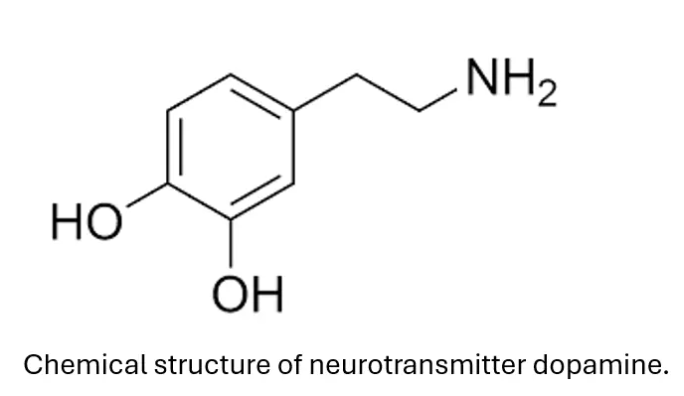
Physiologically, ADHD brains are characterised by smaller volumes of certain regions of the brain, including in the prefrontal cortex/PFC (responsible for high level executive function) and basal ganglia (controlling emotional regulation and habit formation). Research published in the National Institutes of Health reports that the reward pathway in the brain is also impacted; Dopamine is the primary neurotransmitter which makes us feel happy, and it is often released in our brains as a reward for completing a task, received by dopamine transporters. In ADHD brains, there are excessive dopamine transporters, leading to a reduced impact and feeling from a normal dose of the neurotransmitter, often leading to issues in motivation.
Cortical thickness in ADHD brains often peaks at a later age than that of neurotypical brains. Cortical thickness is the measure of the width of the brain’s grey matter, a type of brain tissue, and when it peaks, it signals that the brain has reached a level of maturity. Delayed maturity may objectively appear as a disadvantage, however, it has been scientifically proven that as the brain matures, its neuroplasticity - ability to form new physical connections in order to adapt and learn - reduces as we age. Therefore, ADHD brains remain highly neuroplastic for longer - in other words, allowing an individual to learn to a greater capacity and higher speed.
As well as this, the brain’s wakeful unoccupied mental state, Default Mode Network (DMN) is unique in ADHD brains. This state is characterised by self-reflection, the recall of memories, or planning and daydreaming. However, when a goal-based task does become the main focus, DMN is meant to deactivate, and flow into the Task Positive Network (TPN). A third system called the ‘Salience Network’ is used as a switch to move between the two, and this requires a dopamine spike - but there is a higher spike threshold required for those with ADHD. This often results in an underlying presence of DMN, even during task-focused activities.
Unique Abilities
It is crucial to remember that these differences are not indicative of intelligence, but instead, how the brain manages executive functions. On average, individuals with ADHD have higher creative skills, uniquely rapid problem solving abilities and heightened levels of pattern recognition.
High creativity in individuals with ADHD is driven by neural networks which favour divergent thinking. Whilst focus on a singular task may be reduced by over-sensitivity to dopamine, this allows more information and sensory input to enter one’s conscious awareness. In addition to this, in order to compensate for lowered dopamine, the brain searches for interesting stimulation to provide short bursts of dopamine release to reduce boredom. This behaviour is known as novelty-seeking, and it can result in the creation of unique and unconventional ideas.
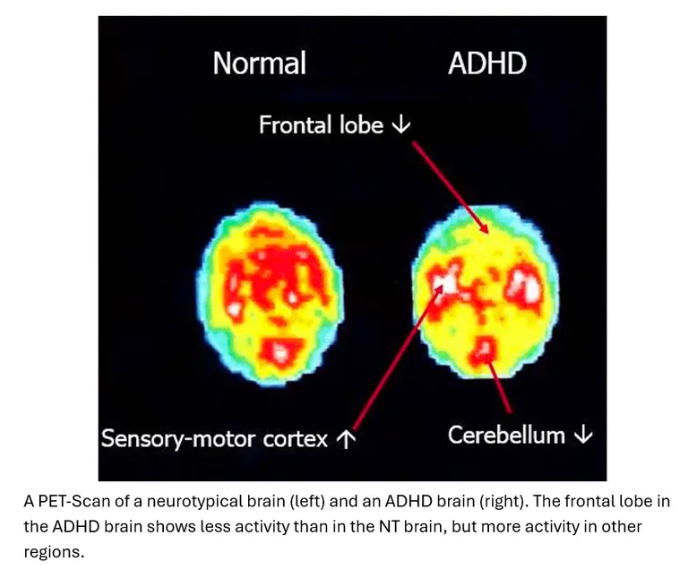
Whilst ADHD brains may have lowered activity in the prefrontal cortex and basal ganglia, the brain can recruit other neural networks, and enhance their activity. This is known as Neural Compensation which can allow for rapid, insight-driven problem-solving. Some of the areas of the brain engaged in neural compensation are the occipital lobe (at the back of the head, where visual data is processed) during tasks requiring verbal rehearsal, suggesting a reliance on visualisation to aid processing. Used for interpreting sensory information, the parietal cortex is often observed to be hyperactive as well, and is utilised to offer support for the spatial vigilance.
The cerebellum is a structure at the base of the brain, primarily responsible for the coordination of motor movements, and its volume is sometimes seen as reduced in individuals with ADHD. Although, as many age, its activity increases due to Neural Compensation. An enhanced functional connectivity is observed between itself and other regions, such as a lobe of the frontal region of the brain, known as the middle frontal gyrus, used for maintaining working memory. This enhances and stabilises spatial working memory where the PFC may struggle. As well as this, the cerebellum’s hyperactivity has been observed to sharpen the brain’s sensitivity in tasks involving using a stop signal, acting as a fail-safe feature. Whilst the prefrontal cortex is still responsible for sending the final ‘stop’ response, the cerebellum has been seen to store predictions of the outcome of movements. This means that if the individual’s current movements do not match the intention of stopping, such as a foot pressing on an accelerator, it sends a corrective signal which interrupts the action.
Neuroscientific research also suggests that ADHD brains have enhanced pattern recognition. This is due to an increased synaptic density (number of connections between neurones) in visual regions. In neurotypical brains, a process known as synaptic pruning removes weak or rarely used connections to increase efficiency. For those with ADHD, this process is slower, leading to an ultimately higher synaptic density. This results in more physical pathways for information to travel through in the brain, sometimes simultaneously, creating a ‘web’ effect. Therefore, seeing a piece of a pattern in an ADHD brain means that data can be compiled or connected to memories faster than a synaptically pruned brain - allowing enhanced recognition of patterns. The higher synaptic density also means that environments and images can be more rapidly scanned, and so processed faster.
Evolutionary Origins
Further supporting the central idea of neurodiversity, that no brain functions are inherently ‘abnormal’, are the theorised evolutionary origins of ADHD.
ADHD brains were suited to early humans’ need for strong vigilance. Norepinephrine, or noradrenaline, is the body’s hormone for alertness. ADHD brains often experience a dysregulation of the hormone. This can result in an unstable level of focus, as the concentrations of norepinephrine do not remain at a consistent baseline, but are instead released in bursts in response to external sensory data, creating hyper-awareness. This combines with the consistently active DMN, allowing ADHD individuals to be both internally and externally aware. This would have been particularly beneficial to early humans in maintaining safety.
Exploration was a skill required by early humans for almost every aspect of survival, from finding shelter to locating food. Generally speaking, the human brain constantly chooses between exploiting an existing reward, or continually exploring for more. The lowered dopamine levels in ADHD brains result in novelty-seeking behaviours, resulting in a greater affinity to exploration. Furthermore, the weaker connection between the PFC and the reward centre in the basal ganglia reduces a phenomenon known as ‘task-lock’, which keeps people focused on repeating the same actions to receive a reward. For that reason, ADHD individuals would have been more inclined to explore further, rather than staying to continue utilising a known ‘reward’/resource.
In conclusion, neuroscientific discoveries on the physiology and function of neurodivergent brains enable us as a society to recognise and celebrate neurodiversity as distinct methods of managing executive functions - and that as individuals, we all possess unique skill sets.