





By Eva B, Year 12
How significant a role has White Christian Nationalism played within the MAGA movement in the United States?
Defining White Christian Nationalism
A version of Christian Nationalism, comparable to how we view it today, first emerged during the American War of Independence 1775-1783. Although Christian Nationalism has continued to exist in a range of different forms in the United States of America over the last two hundred and fifty years, it has attained notable significance in the last five years, particularly since the January 6th 2021 riots at the US Capitol. Christian Nationalism can be perceived as an integral faction within President Donald J Trump’s second administration. Christian Nationalist groups and individuals now form a significant strand of the wider Make America Great Again (MAGA) movement, primarily campaigning for the fusion of their radical interpretation of Christian doctrine with more traditional conservative ideologies within an American context. The influence of these ideas within the Trump administration was made clear at a celebration of National Prayer Day in 2025 when the President stated “They say separation between church and state… I said ‘Alright let’s forget about that’”. Here, President Trump echoed a core Christian Nationalist belief of the fusion of Church and State. Some writers refer to ‘White Christian Nationalism’, drawing attention to a racial component of some elements of Christian Nationalism, which can be traced back as far as the eighteenth century focused around privileged ethnicities such as those of Anglo-American or Franco-American descent. As a result of immigration from other European countries throughout the nineteenth century, the term ‘White’ has now expanded to reference anyone of European descent, becoming linked to skin colour as a form of identity. Additionally, what is meant by ‘Christian’ has also developed. Originally, this meant the high concentration of Protestant denominations which were present in America during its founding period. Within the last half century or more, the Christian identity has expanded to include many Catholics, Mormons and even some Jews, under the term “Judeo-Christian values”. The Christian Nationalist movement possesses quite a few anti-semitic beliefs and elements, but it is also accepting of certain individuals and institutions which are supportive of the state of Israel and the policies of the Netenyahu administration. Netenyahu’s government is widely perceived to be ideologically sympathetic to the MAGA movement and the Trump administration, and vice versa, revealing complexities and contradictions within the movement as a whole. Within the broader movement of White Christian Nationalism, the term ‘Nationalist’ is defined, here, as distinct from the term ‘Patriot’. The two terms are sometimes treated as synonymous; however, whereas ‘Patriotism’ can be defined, as Philip Gorski puts it, as “an adherence to the ideals of the United States”, Nationalism is predicated upon the exclusion of those perceived to be alien and inferior. To an extent, the Christian Nationalist movement is also predicated on traditionalist outlooks towards gender, seeking its basis in biblical texts, with rhetoric often asserting perceived masculine traits.
The Development of White Christian Nationalism
The emergence of White Christian Nationalism in the 18th Century during the founding years of The United States, was a different version of the movement we know today due to the shifting definitions of ‘White’, ‘Christian’ and ‘Nationalism’. However, there are some continuities, with some contemporary Nationalist rhetoric citing 18th century language and concepts as justification. Such views are expressed by David Barton, who argues that, “What is normal is heterosexual, and that is the law of nature and it’s a law of nature’s God”. Barton, despite having no relevant academic qualifications, is the founder of a non-profit dedicated to America’s “constitutional, moral and religious heritage”. A significant shift in ideology centred on the January 6th 2021 riots at the US Capitol, which were organised rallies by Trump supporters in an attempt to challenge the certification of the results of the 2020 presidential election. The principles of Christian Nationalism served as ideological fuel for the riots, an attitude which “clearly merges national power and divine authority…’good guy violence’ for the sake of maintaining a certain social order”. Since Trump’s election to a second term, in 2024, this attitude has gone on to permeate the executive, legislative and judicial branches of the federal government, as well as at state level government, especially in ‘red states’. For example there is a positive correlation between Texas’s near-total abortion ban and the fact that 100% of the 38 voting congressional delegations in Texas identify as Christians. While being a Christian does not equate to identifying with the Christian Nationalist movement, the values taught in certain denominations evidently overlap with Christian Nationalist ones. The version of the Christian Nationalist movement present during the extended foundations of the United States, in the 18th and 19th century, was pioneered by White Christians, who in part defined themselves in terms of alienation from and superiority to non-White groups, including not only Black Americans and Native Americans but also Hispanic-Americans and Chinese-Americans. Black Americans made up a significant proportion of the late 18th century and early 19th century population of the United States. The number of the enslaved Black population reached 1.19 million in 1810 (this was 1/7 of the overall population). Morgan Godwyn, an Anglican Priest during the colonial, pre-Revolutionary era, in 1681 laid out the 2 common forms of racist theology. These were pre-Adamism, which theorised that two sets of human species had been created by God, and argued that solely ‘Adamites’ and not the ‘pre-Adamites’, were in possession of a soul. This theology was further examined in 1701, when pro-slavery theologians utilised the theory of the ‘Curse Matrix’. This was the belief that black skin was God’s curse and therefore slavery was a saviour to African Americans. They believed that Black Americans would therefore reach salvation through exposure to the ‘divinity’ of Christianity and white civilisation, which was utilised to justify 18th century racism. There was a fusion between Protestantism, the main denomination of Christianity present in 18th century America, with the emerging political identities of Federalists and Democratic-Republicans. Despite many of the Founding Fathers' own Christian belief systems leading to a large biblical justification for their policies, there was a notable lack of reference to religion in the US constitution; in fact, the First Amendment of the Constitution, in 1789, explicitly states "Congress shall make no law respecting an establishment of religion, or prohibiting the free exercise thereof". However, Protestantism continued to have a privileged status because it was the primary religion of Anglo-Americans, Franco-Americans and German-Americans who made up the majority of the population of the United States until the Civil War period, meaning that racial and ethnic identity was tied up with religious identity, defined often in opposition to a Black or Native American, or other non-White groups, who were treated as ‘Other’. Different stages of immigration, including from Southern and Eastern Europe in the late nineteenth and early twentieth centuries, and from Central and South America and Asia in the twentieth and twenty-first centuries have led to periodic anti-immigrant and often nationalistic sentiment. However, a significant moment in the development of Christian Nationalism was the election of the first Black President of the United States, Barack Obama in November 2008.
The Role Played by White Christian Nationalism within the MAGA Movement
Obama’s election crystallised fears of ‘cultural marginalization’ among White Christian Nationalist groups. Since the founding of the United States, the dominant political class had been characterised by Protestantism and White ethnicity in the main. As recently as 1960, the Catholicism of John F Kennedy had been seen as problematic. When elected in 2020, Joe Biden was only the second US president in history not to have been a member of a Protestant denomination, suggesting, as Philip S Gorski and Samuel L Perry argue in ‘The Flag and the Cross’, that when Christian Nationalists hold the majority of power and influence, they become increasingly accepting of other minorities’ participation within the political life of the nation due to their own hegemony. However, particularly since the 1960s, which combined voting rights for Black Americans with increased immigration from Central and South America and Asia, there has been an increased anxiety about White Protestant hegemony being under threat among the groups chronicled by Gorski and Perry. In addition, since 9/11 and the war in Iraq, in particular, there has been an increase in Islamophobia in the United States, with Trump himself during a 2016 CNN interview stating “I think Islam hates us” aiding the spread of misinformation. This sense of insecurity has been rooted in a perception of a threat to White Christian hegemony. The demographic shift from the 1960s led to members of denominations such as Catholics and Mormons increasingly being aligned with the Christian Nationalist movement; an early sign of this transition was the populist presidential run by Catholic Pat Buchanan in the early 1990s which anticipated aspects of the 2016 Trump campaign, with some Conservatives viewing him as a ‘proto-Trump’ including Nick Solheim (head of an influential right wing non-profit) who argued that Buchanan, “stood and believed in all the same things that the president (Trump) ran on…specifically…his views on trade, immigration and foreign policy”. Conservative philosopher, Yoram Hazony argues that Christian Nationalism has become a vehicle for the “unique national traditions of peoples chafing against ideas and institutions which they regarded as foreign to them”. This attitude of insecurity was further catalysed by Obama’s two terms as President, which helped shape a backlash among such groups that helped fuel Donald J Trump’s successful campaign for President in 2016. This manifested in the MAGA movement as the core group of White Protestant Evangelical Christians in particular (who remain the MAGA base in 2026, 10 years later). Furthermore, the number of White Christians, including former Catholics and Mormons, as well as Episcopalians, now identifying as ‘Evangelicals’ or ‘Born Again’ Christians is increasing, with a significant number aligning themselves with nationalist forms of Christianity, identifying with MAGA and overwhelmingly voting for Republican (and Trump-backed) candidates. Trump himself lacks a clearly devout Christian faith, having been raised Presbyterian and now identifying as non-denominational, but has consistently advocated ideas throughout his political career, in particular surrounding his anti-immigration stance and in his critical comments about civil rights, that aligned with the White Nationalist movement. Their perception of Trump as a strong leader, rooted in White Nationalist values meant that his core voters have historically seen him in ideological terms, therefore caring less about his potentially questionable ethics, for example his consistent spreading of evident disinformation, misinformation and factually inaccurate statements. In addition, his long history as a media celebrity for over forty years, including his appearance in the top-rated ‘The Apprentice’ on NBC from 2004-2015 allowed him to cultivate a body of fans with arguably unprecedented levels of loyalty and devotion in regard to a political figure. This helps to explain how Trump has not been held to account for the amount of false or misleading statements that he makes (for example The Washington Post documented 30,573 such claims during his first presidential term, an average of 21 a day). However, in other ways, Trump could be seen to be more ‘honest’ than some of his Republican predecessors, such as Reagan and Nixon in particular, in being direct in his revelation of his racist attitudes. Instead of using ‘dog whistle politics’ (the political tactic of using coded messaging in political rhetoric to appeal to extremist attitudes while not being explicit, so that the politician could deny that was what they were doing), Gorski and Perry argue that Trump “exchanged the dog whistles for a bullhorn”, running what was essentially an ethno-nationalist campaign in 2015. Here he appealed to White Christian Nationalists by defining the United States in terms of White and European ethnicity and also in terms of ‘Christian values’, which meant those values aligned with conservative Protestant evangelicals in particular. Therefore, within Trump’s MAGA movement, Conservative Christianity and White Nationalism have become allied and have increasingly overlapped between 2015 and 2026, with increasing links to parallel groups such as Victor Orban in Hungary. During Trump’s second term, beginning in January 2025, the White Christian Nationalist aspect of his administration has become more explicit under Stephen Miller, with the ICE agency enforcing stricter immigration than previously, particularly targeting non-White groups, such as Mexicans and Guatemalans. The abandonment of ‘dog whistle politics’ by Trump, Miller and other members of Trump’s second administration, including the explicitly Christian Nationalist Secretary of State for Defence, Pete Hegseth, has solidified the MAGA movement as increasingly driven by White Christian Nationalist ideology. There was controversy recently when Hegseth made a speech on D-Day, on 6th June, 2026: “today, different European beaches are stormed by different dangerous ideologies . . . Beaches in Spain, in Italy, in Greece and Bulgaria. Boats and men arrive. When will European capitals do something about that invasion?” This White Nationalist rhetoric has been underpinned by aggression and violence, from the 6th January riot to the actions of ICE agents in shooting or tear gassing unarmed civilians. For White Christian Nationalists, such violence is justified as they perceive it as in the service of protecting a ‘Judeo-Christian’ tradition which is associated with ‘White’ or ‘Western’ values. A common argument which underpins White Christian Nationalist rhetoric is that conservatives should not fight like a traditional Christian, with values of compassion and forgiveness, and instead be fighters for Christian values, which they perceive to be those which align with ‘Western Civilisation’. This is described in terms of White racial identity as well as Christian faith by an increasing number of MAGA members, in line with increasing ethno-nationalist movements in Europe. Trump is described as a fighter for Christians by many of his followers, which means they do not evaluate him by his moral conduct or church attendance but by the fact he is seen to align with their racial and nationalistic identity.
White Christian Nationalism and Gender Identity
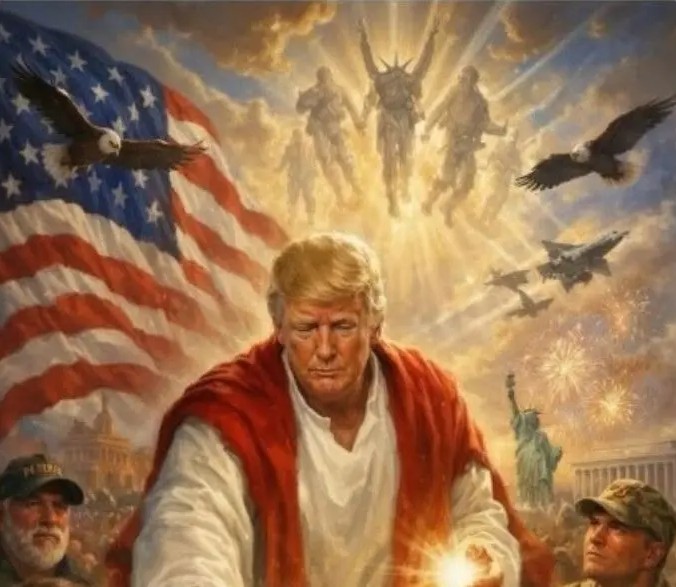
This rhetoric of violence and aggression can be linked to gendered attitudes within the White Christian Nationalist movement, as researched by Kristen de Muz in ‘Jesus and John Wayne,’. John Wayne was seen as an iconic film star in the 1940s and 1950s, a “condensed depiction of White masculine mythology in modern-day America”, representing masculinity as emotionally restrained, individualistic and violent. It is interesting that so many of the men and women who identified John Wayne as representing this version of masculinity should also self-identify as Christian. The version of the figure of Jesus Christ, portrayed in the New Testament, is one of compassion, peace and benevolence, who accepts sacrifice and death without resistance. He invites his followers to embrace the “Other’ (in the form of the Good Samaritan). However, in White Christian Nationalist culture, the figure of Jesus Christ has become increasingly detached from the figure who is so prominent in the Gospels. He has become increasingly synonymous with a presentation of a “(white) man exercising (righteous) violence to defend his freedom and impose (racial and gender) order”, as Gorski put it. The average White Christian American cannot make direct comparisons of themselves to Jesus, who did not own a gun, or have a wife, and therefore have created a ‘Straight White American Jesus’. In fact, some memes and images have linked Jesus and Trump as representing ‘John Wayne masculinity’. Nearly 95% of those who said religious freedom was the most important issue influencing their voting in 2016 voted for Donald Trump, which is arguably shown in memes and in some art works of Trump as Christ-like, including the hyper-masculine version that is increasingly dominant in meme culture. Trump himself posted an AI photo on Truth Social in April 2026 of him seemingly as a Christ-like figure (which he later unconvincingly claimed depicted him as a doctor after receiving backlash) with the American flag in the background, encompassing the movement arguably within one photo. The dominance of White Evangelical Christians within the Christian Nationalist movement in America, and the MAGA movement, is shown by a 2023 survey which concluded that nearly ⅔ of White Evangelical Protestants identify as Christian Nationalists, and are their most supportive group. Additionally, the survey results showed 81% of White Evangelicals voted for Trump in the 2016 election. It is notable that the word “saviour” is used by many evangelicals to describe Trump. As a result, Christian Nationalism is increasingly less predicated on Biblical text and more on ideological attachment to the MAGA movement and the figure of Donald Trump in particular. White Christian Nationalists see their country as an ‘us’ versus ‘them’. They believe that not all who live in the United States are ‘real’ Americans; this includes individuals who identify as Christians but not as White Christian Nationalists. Many of those being targeted for deportation, currently, by ICE identify as Catholics, from countries in Central and South America. Linked to the idea of masculinity as a defining aspect of White Christian Nationalism is a focus on sexuality, with attempts to legislate sexual morality, for example the Defense of Marriage Act (DOMA), in 1996, a federal law which defined marriage as matrimony between one man and one woman, preventing same-sex spouses from receiving federal benefits. Although there has since been progress in terms of the rights of gay couples to marry, in 2015, the final year of Obama’s second term as President, there were many concerns that same-sex marriage may be under threat. Abortion rights have come under pressure since Roe versus Wade (federal protection of abortion rights), another area of focus for many Evangelicals, was overturned by the Supreme Court in 2022. The changing definition of ‘Christianity’ within White Christian Nationalism has arguably played a crucial role in the growing popularity of the movement, among White men in particular.
.jpg)
White Christian Nationalism and Cultural Anxiety
A 2022 PRRI Study into Christian Nationalism found that, as of late 2022 around one in ten Americans are ‘Adherents’ of Christian Nationalism, as well as 56% of Republicans being either Advents or Sympathisers of the movement. This suggests that there is a high correlation, post January 2021, of identifying with the Republican Party and simultaneously the Christian Nationalist movement. Additionally, around 56% of American Christians who regularly attend religious services identify as Christian Nationalist adherents or sympathisers, and 58% of White Church regulars additionally identify as such. This establishes a conspicuous presence of the White Christian Nationalist movement among MAGA voters. Much of Trump’s rhetoric in the lead-up to the 2024 Presidential election was to attempt to appeal to the Christian faction of his supporters, providing a promise to keep the nation a Christian one for his “beautiful Christians”. This is extremely important for those with the belief system of a Christian Nationalist who believe in the intertwining of Church and State (contrary to the First Amendment, as previously noted) as the most focal point of their belief system. Within such rhetoric, to be an American equates to being a Christian, a sentiment which they believe should be applicable to the entire population of the United States and should exclude those who are not Christian from being seen as Americans. Within the PRRI study, there were further findings about the relationship and positive correlation between Christian Nationalists and those who favour Donald Trump as leader of the Republican Party (GOP). For example, traditionally Conservative states like Arkansas and Mississippi have approximately 52 and 51 percent of Christian Nationalists residing within the state, and additionally have on average 53% and 50% of residents holding “favorable views toward Trump”. Contrastingly a traditionally Democratic state such as Washington was found to have an average percentage of 24% of Christian Nationalists in residence, with only 31 percent holding favourable views of Donald Trump. The prominence of Christian Nationalists, and their perception of Trump as a figure ‘anointed by God’ plays a key role in their prominence within the MAGA movement. The idea that Trump is a figure who has been ‘anointed’ was further emphasised by the assassination attempt on 13th July 2024 in Butler Pennsylvania, cementing the idea, within a particular subsection of Trump’s Christian following (Evangelical leader Franklin Graham believed “God turned his head and saved his life”) that Trump, and therefore right wing politics, is increasingly becoming synonymous with religion among Christian Nationalists in America, suggesting they play a significant role in his administration. The image of Trump as comparable to a God-like figure was overriding any alternate factors which could have influenced how they used their vote in the 2024 presidential election, such as economic or social policies. Furthermore this deification of Donald Trump may have caused the disregard among Republicans towards the accusations against Donald Trump of sexual and professional misconduct, such as his affair with Stormy Daniels, the sexual abuse of E Jean Carrol, of which he was found liable for $83.3million in damages in civil court in 2022, or his impeachment over allegedly seeking help from Ukraine to boost his chances of a successful election in 2020. Trump himself implicitly acknowledged his own lack of moral behaviour or lack of Christian belief by emphasising that he was there as a vehicle for churches: persuading the Christian electorate that “if you elect me, I’m going to restore power to the Christian churches” He did this by inciting the fear of many Christian Nationalists by empathising that “I know you're in decline, I know your numbers are waning.” He understood their fears of becoming a marginalised group within America and capitalised on this. Fears of marginalisation, specifically for American White Christian Nationalists are perhaps the largest driving force for their cause, shaped by demographic shifts and by the election of America’s first Black President in 2008. During the 2024 presidential campaign, some White Christians expressed concern that, in contrast to President Joe Biden, a high profile Catholic, repeatedly seen with ash on his forehead to mark Ash Wednesday, his Vice President, Kamala Harris (the 2024 Democratic nominee) seemed to lack a personal commitment to her own faith (as, of course, did her Republican opponent, Donald Trump). While Harris emphasised the importance of compassion and inclusion of LGBTQ+ rights, gender equality and immigration, Trump instead positioned himself as a “protector of Christians”who he described as being under threat, feeding their sense of insecurity. Trump spoke about being brought up Presbyterian, a denomination of Protestant Christianity; however, in 2020 he told Religious News Service that he no longer aligns with the denominational church, and now considers himself to be a non-denominational Christian.
Some commentators have suggested that such anxieties were heightened during the increasing prominence of the Black Lives Matter movement in the wake of the killing of George Floyd, in 2020. Others have seen the Capitol riots of 6th January, 2021, which can be seen in part as a reaction against BLM, as a more significant moment for the White Christian Nationalist movement. This reflects an increased comfort within the movement of becoming involved in violent and illiberal forms of political action in conflict with, for example, the Fifteenth Amendment. This is argued by Laura K Field in ‘Furious Minds’, in regard to National Conservatives, a parallel emerging group to the White Christian Nationalists. Field notes that many of the rioters at the Capitol were armed with not only wooden gallows (symbolising extra-judicial lynching) and bullet proof vests, but also “Jesus Saves” signs, suggesting elements of Christian Nationalism present. Field draws attention to the rejection of pluralism (the notion that power should be dispersed and shared among a variety of interests and ideologies, reflecting a system of checks and balances, rather than dominance by a single individual or small elite group). Capitol rioters claimed that the election had been ‘stolen’ in favour of Democratic presidential candidate Joe Biden (despite no evidence of such election theft or fraud being demonstrated in any court of law). What was even more notable was the role played by Donald Trump, who was on the record with such phrases as “We will stop the steal” and “If you don’t fight like hell you’re not going to have a country anymore” (leading to a congressional attempt at impeachment for ‘incitement of insurrection’). Significantly, Trump also referred to the Capitol riots as “an assault on Christianity” - which was aimed at the deep core of evangelical and Christian Nationalist support within his MAGA base, feeding into their sense of insecurity and offering a “symbolic defence of the United States’ perceived Christian heritage”. However, this was only one example of the way in which Trump incited anger among Christian supporters during the election campaign, for example at a 2020 rally in Ohio he accused Biden of trying to “Hurt the Bible, hurt God. He’s against God, he’s against guns”. Thus, a commitment to ‘fight’ for the preservation of White Christian religious and cultural status lay explicitly at the heart of the wider MAGA movement, bridging evangelical Christianity and White Nationalism, clear from the number of Christian leaders at the heart of the MAGA movement and of the Trump administration.
Conclusion
In conclusion, while the ideology of White Christian Nationalism has significantly evolved since the period of the foundation of the United States of America in the late 18th century, there have been a number of continuities. Christian Nationalism in the 21st century continues to hinge on the alienation of groups which it perceives to be ‘Other’ in order to retain power, politically and socially, for White Christians (often male) within the United States. Christian Nationalist groups are reliant on Right-wing politicians, primarily Republican and more broadly within the MAGA movement, to achieve their stated primary goal of the fusion of church and state, with the ultimate goal being the abolition of the separation of powers. The crux of why President Donald Trump is so integral to the Christian Nationalist movement is that he does not commit himself to one specific part of the Christian doctrine and therefore he can be seen to be manipulated by the Christian Nationalists as their instrument in the form a perceived divine protector, in his executive capacity as President, to effect a push-back back against Progressive legislation and court rulings in fields such as gay rights, women’s rights, Black voting rights and the overlap of church and state. For White Christian Nationalists, the importance of a President who openly rejects traditional Republican ‘dog whistle politics’ tactics in order to pursue an explicitly and overtly race-based and gender-based agenda cannot be understated. Furthermore, he has mirrored the language of individuals such as Gad Saad in critiquing traditional values of taught Christianity such as compassion or empathy. Trump's additional traditional masculine persona that he often exercises while on official presidential duties allow him to additionally represent idealised masculine attributes for Chrisitian Nationalists. Thus, Trump’s questionable personal morality, in conventional Christian terms, is overlooked by Christian Nationalists for the sake of his aggressive assertion of their own ideology. For Trump, Christian Nationalists, as a significant proportion of his MAGA electoral base, offer unswerving political support. The large numbers of Christians who voted for the White Straight Christian Man over the South African and Caribbean Woman in the 2024 Presidential race, confirmed, to Trump himself, how strong an overlap there is between the MAGA movement, the Trump administration and White Christian Nationalist groups, in terms of rhetoric, values and ideology. Trump and the Christian Nationalist leaders see the need for continued alliance and mutual support in reaction against demographic shifts in the United States that point towards increased secularism and diversity.
Bibliography:
“Capitol Riots: Did Trump’s words at rally incite violence?”. BBC News, 14th February 2021, https://www.bbc.co.uk/news/world-us-canada-55640437
Bible Authenticity.“False Messiahs of Jesus’ prophecy is coming true”. Bible Authenticity, 17th November 2024, https://bibleauthenticity.com/false-messiahs-of-jesus-prophecy-is-coming-true/
“Pluralism”. Britannica, https://www.britannica.com/topic/pluralism-politics
Brockes, Emma. “As the Epstein case shows, Trump’s MAGA faithful care about only one kind of sex-crime victim”. The Guardian, 11th September 2025, https://www.theguardian.com/commentisfree/2025/sep/11/trump-epstein-carroll-sexual-abuse-birthday-book
Conant, Caitlin. “Trump falsely says Biden, a practicing Catholic, is “against God "". CBS News, 7th August 2020, https://www.cbsnews.com/news/trump-biden-against-god-false-claim/
Dias, Elizabeth. “Trump Promises to Bring About a New Era of Christian Power”. The New York Times, 3rd November 2024, https://www.nytimes.com/2024/11/03/us/trump-christian-religion.html - accessed 14th June 2026
Duignan, Brian. "January 6 U.S. Capitol attack". Encyclopedia Britannica, 18 May. 2026, https://www.britannica.com/event/January-6-U-S-Capitol-attack. Accessed 1 June 2026.
Edsall, Thomas B. “The Capitol Insurrection Was as Christian Nationalist as It Gets”. New York Times, 28th January 2021, https://www.nytimes.com/2021/01/28/opinion/christian-nationalists-capitol-attack.html Accessed 1st June 2026
Farley, Harry. “Trump’s Christian supporters and the march on the Capitol”. BBC News, 15th January 2021, https://www.bbc.co.uk/news/world-us-canada-55578096
Field, Laura K. Furious Minds. Princeton University Press, 2025.
Image: via https://www.theguardian.com/us-news/2026/apr/19/trump-religious-right-pope-feud-ai-jesus-posts @realDonaldTrump on Truth Social 13th April 2026
Gorski, Phillip. L Perry, Samuel. The Flag and the Cross. Oxford University Press, 2022.
Herman, Alice. “Trump courts Christian vote and says ‘God saved me for a purpose’”. The Guardian, 22nd October 2024, https://www.theguardian.com/us-news/2024/oct/21/trump-christians-vote-us-election
Jacobs, Ben. “Pat Buchanan gets the last laugh”. Congressman Riley M. Moore 2nd District of West Virginia website, 5th September 2025, https://rileymoore.house.gov/media/in-the-news/politico-pat-buchanan-gets-last-laugh
Kobes du Mez, Kristen. Jesus and John Wayne. W.W Norton & Company, 2021
Maqbool, Aleem. “‘Anointed by God’: The Christians who see Trump as their saviour”. BBC News, 16th November 2024, https://www.bbc.co.uk/news/articles/c20g1zvgj4do
Public Religion Research Institute (PRRI). “Mapping Christian Nationalism Across the 50 States: Insights from PRRI’s 2025 American Values Atlas”. PRRI, 17th February 2026, https://prri.org/research/mapping-christian-nationalism-across-the-50-states-insights-from-prris-2025-american-values-atlas/
Public Religion Research Institute (PRRI) and Brookings Institution. “Survey: Two-Thirds of White Evangelicals, Most Republicans Sympathetic to Christian Nationalism”. PRRI, 8th February 2023, 2023 PRRI/Brookings survey,
Sandstrom, Aleksandra. “Majority of states have all Christian congression delegations”. Pew Research Centre, 21st March 2017, https://www.pewresearch.org/short-reads/2017/03/21/majority-of-states-have-all-christian-congressional-delegations/
Schleifer, Theodore.”Donald Trump: ‘I think Islam hates us’”. CNN Politics, 10th March 2016, https://edition.cnn.com/2016/03/09/politics/donald-trump-islam-hates-us
Seitz-Wald, Alex. “Harris goes to church, highlighting the absence of religion in the 2024 campaign”. NBC News, 20th October 2024, https://www.nbcnews.com/politics/2024-election/harris-goes-church-highlighting-absence-religion-2024-campaign-rcna176045
Sentner, Irie. “Trump, brushing aside separation of church and state, establishes religious liberty commission”. Politico, 5th January 2025, https://www.politico.com/news/2025/05/01/trump-religious-commission-church-state-00321814.
Silliman, Daniel. “Trump Becomes the First President Since Eisenhower to change Faiths in Office”. Christianity Today, 27th October 2020, https://www.christianitytoday.com/2020/10/trump-nondenominational-presbyterian-religious-eisenhower/.
“David Barton”. Southern Poverty Law Centre site, 26th May 2012, https://www.splcenter.org/resources/extremist-files/david-barton/
“Remarks by Secretary of War Pete Hegseth at the 82nd Anniversary of the D-Day Landings at Normandy American Cemetery (As Delivered) June 6, 2026”. U.S Department of War, 9th June 2026,
“Demographic History of the United States”. Wikipedia, https://en.wikipedia.org/wiki/Demographic_history_of_the_United_States
False or misleading statements by Donald Trump”. Wikipedia, https://en.wikipedia.org/wiki/False_or_misleading_statements_by_Donald_Trump